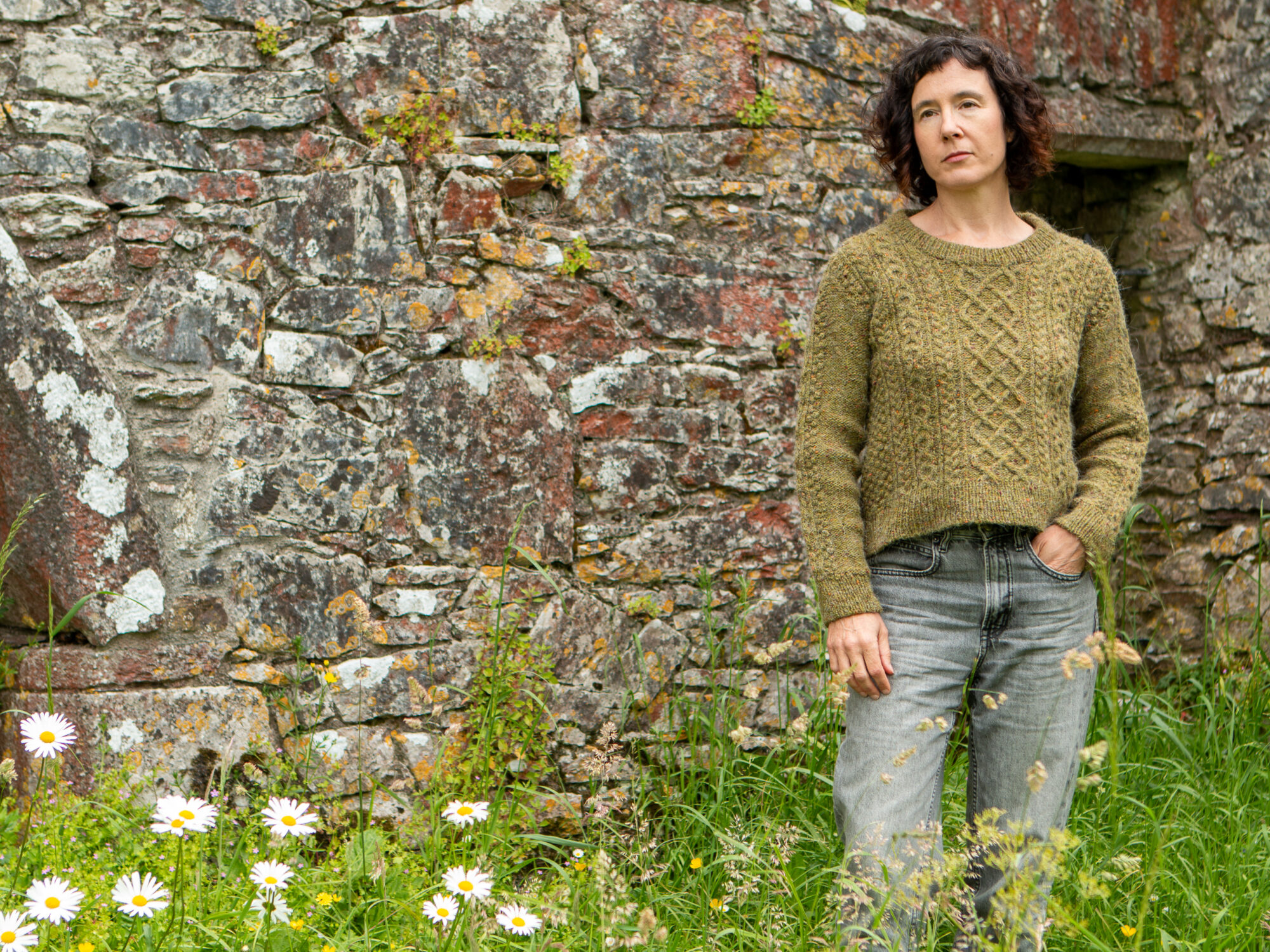
This year’s Celtic Knits Club had the theme of ‘Aran Evolution’ and I wanted my final, sweater pattern to live up this. I will admit, it felt like a big brief, trying to take the tradition and cables and fold it into a more updated silhouette.
I’m also very much in love with the finished sweater!
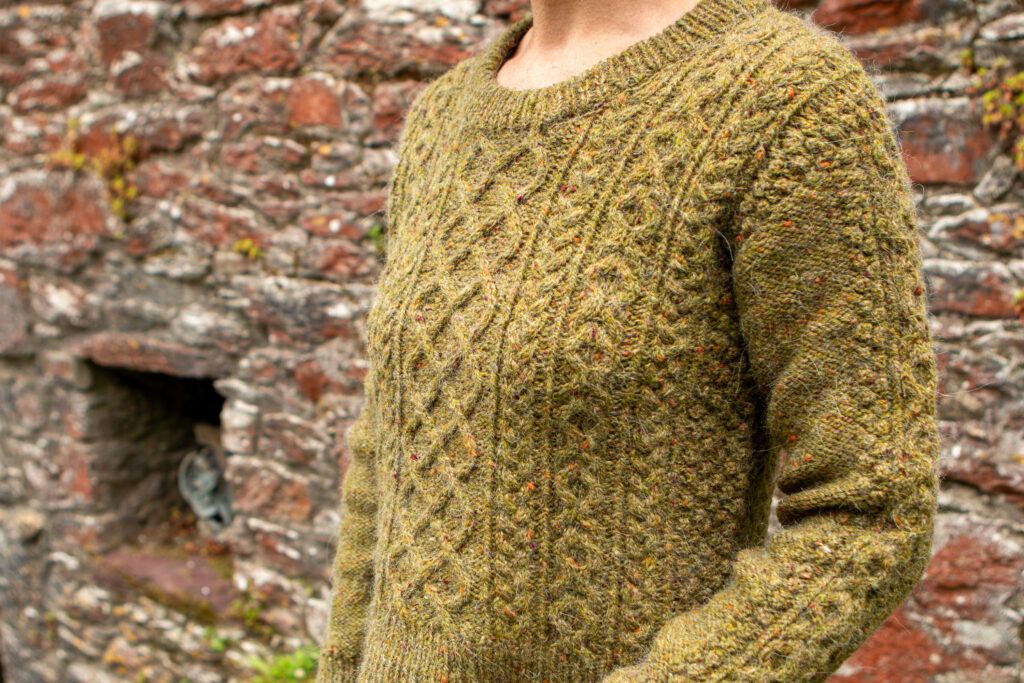
It alternates between several smaller cable motifs with a larger central panel and of course some Blackberry Stitch along the side. While the cable stitches are very traditional I played around with the construction, adding some fun details.
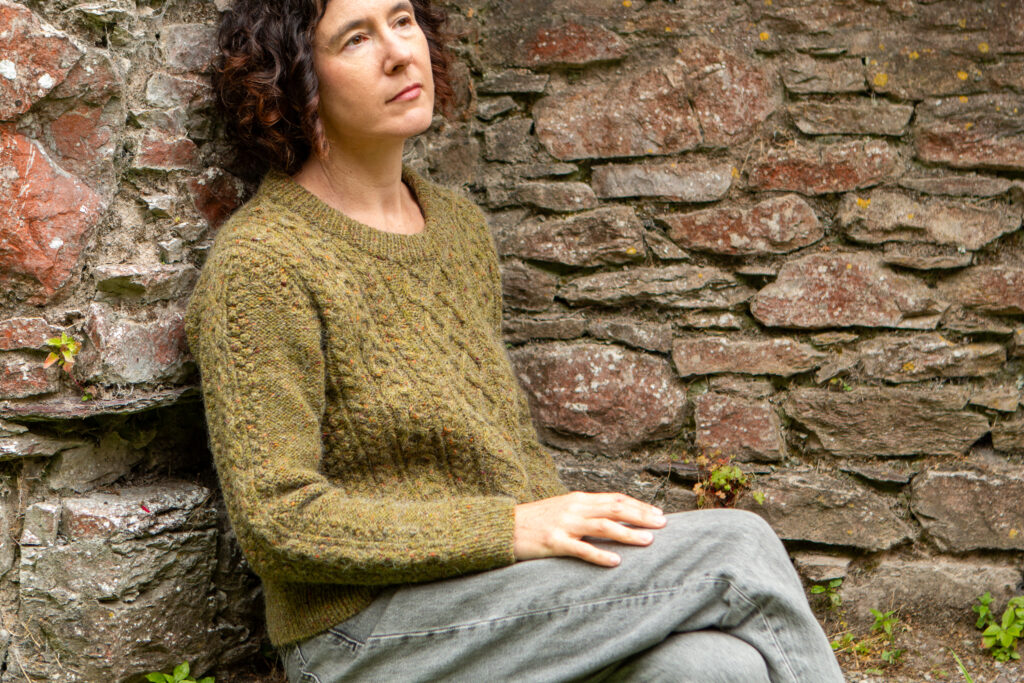
The sweater is worked from the top down in one piece. The back is worked first to the underarm flat and then stitches are picked up for each side of the front and worked down also. At the underarm you join to work in the round and Blackberry Stitch is added down the side. For a couple of the sizes there is a little Blackberry worked at the side of the upper body, but for most it begins at the underarm.
Every size will have all over cables, adding more repeats as the sizes get bigger. This sweater is a modified drop-shoulder. The shoulders are not as wide as a standard drop shoulder, but instead need to be increased at the underarm. They do sit further out than the true shoulder width, so they are wider than the shoulder would be for a set-in sleeve construction.
European Shoulder
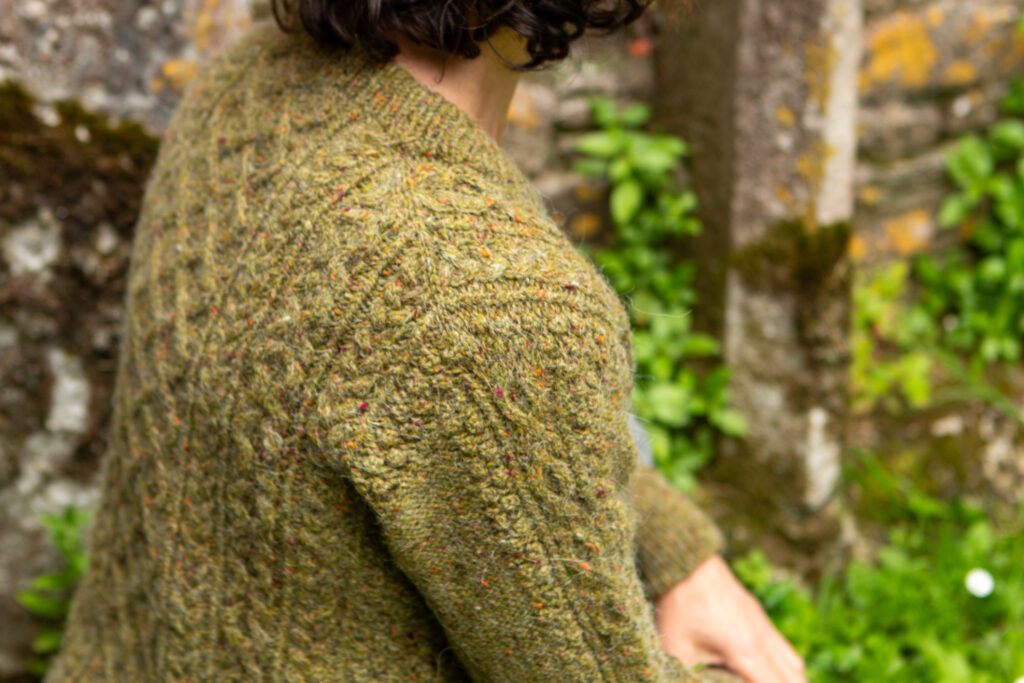
I really enjoyed created the European shoulder type for Aislinn. This is also known as a Diagonal or Tailored Shoulder. All of the shaping happens on the back shoulder. You start by casting on just the neck stitches, then increasing at each end on both the right and wrong side rows. This creates a steep shoulder slope.
Effectively with this shoulder you are putting all of the increases on the back. This allows you to pick up the stitches from each side of the front and work them straight without shaping until you want to introduce neck shaping.
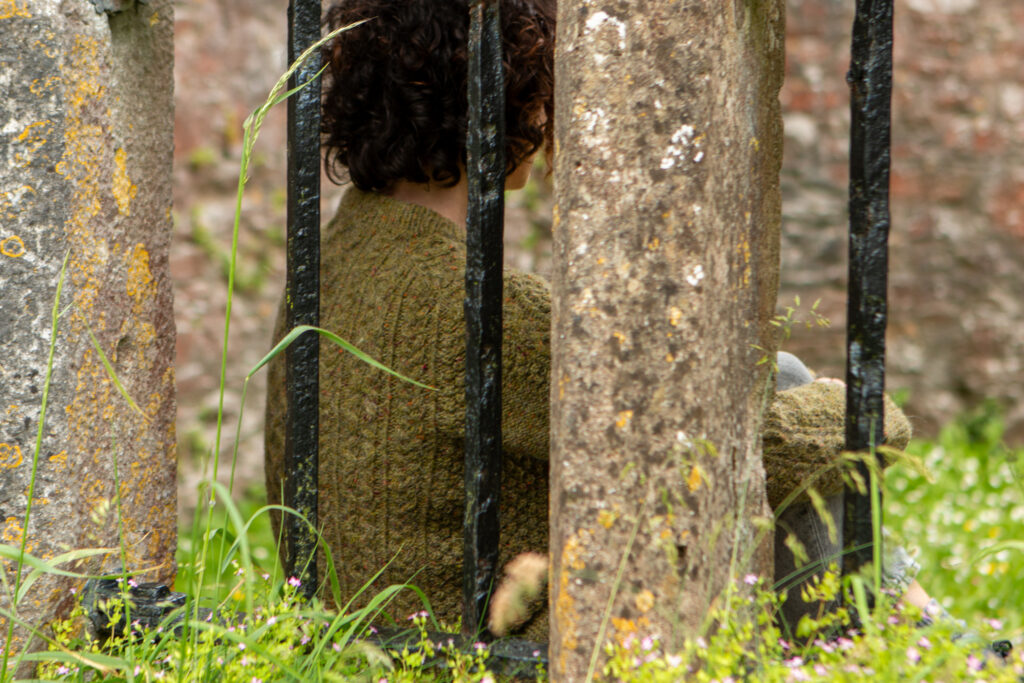
When all of the shaping is on the back it shifts the shoulder seam towards the back of the shoulder. You can see on the photo above that this means that the top of the sleeve is forward of the shoulder seam. Many people find that this gives a more comfortable fit around the neck as it pulls up and over around the sides of the neck.
In the pattern this shoulder increase is fully charted (and written out) for all sizes. You won’t need to guess where to add your cables, it’s all completely detailed for you.
Yarn
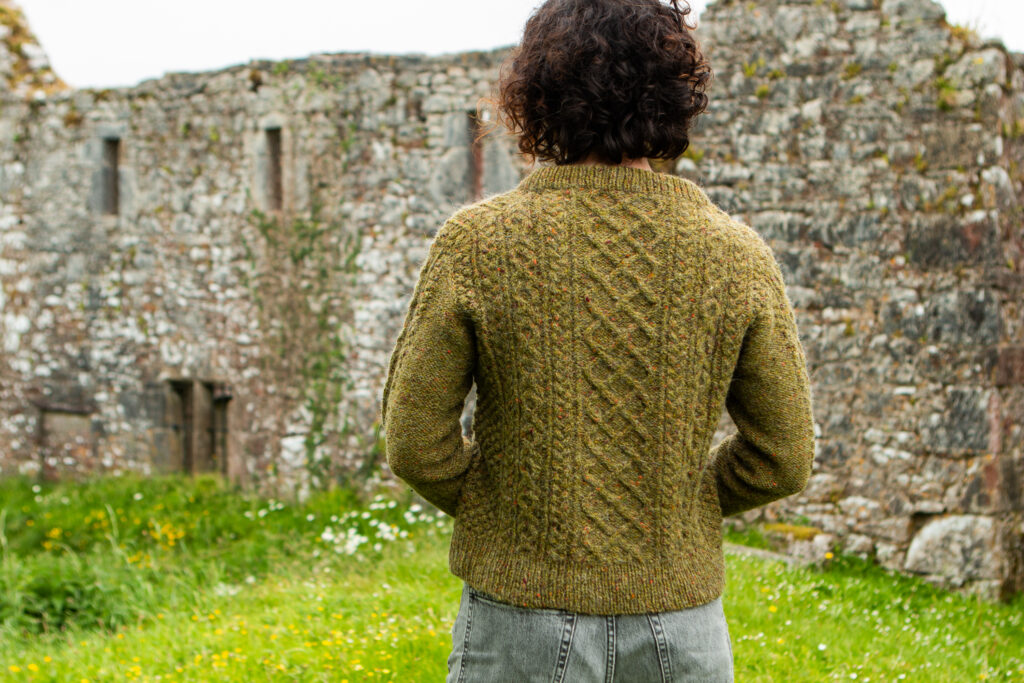
This sweater was the first time I was using our new yarn, Milis, that was spun for us by Dongeal yarns. It is mix of 70% wool and 30% alpaca. If you scroll down you will see the halo you get from the alpaca fiber content.
The 70% wool is a mix of 58% Irish wool and 12% merino burrs. You see those bright specks of colour scatter throughout and those are the burrs? They are STUNNING.
They are small felted burrs of merino that are blended in when the different coloured fleeces are mixed. Because the are felted the retain their colour without becoming fully blended with the other fleece colours.
If you are a member of our digital club you will have exclusive access to the very special yarn. If you prefer a 100% wool yarn then Blasta will also make a very good substitute for Milis.
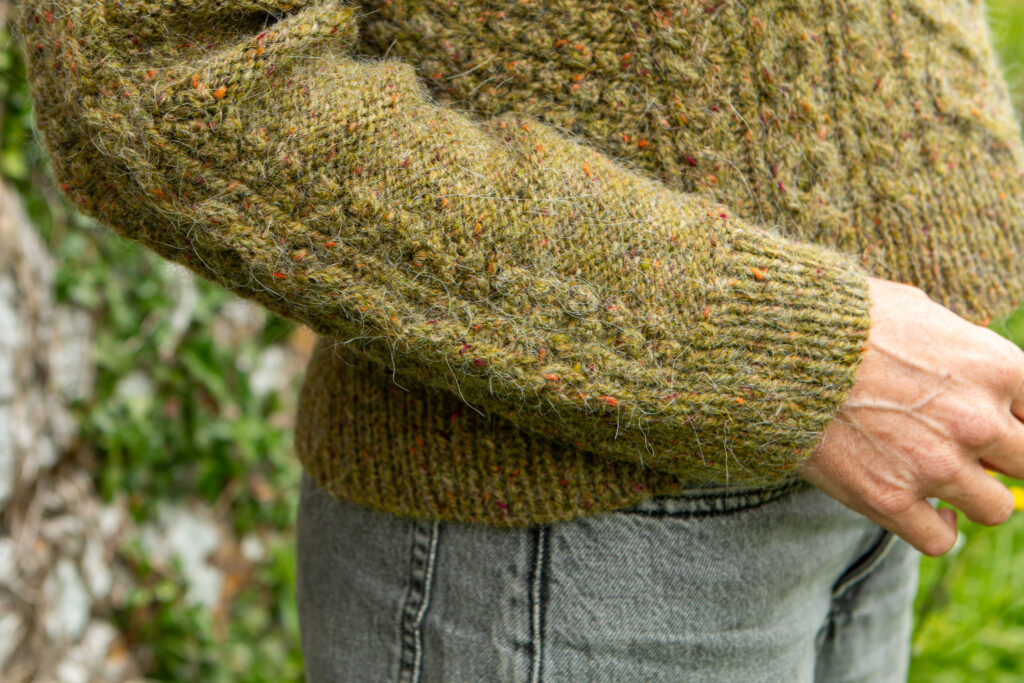
Here on the sleeve you can see that a small cable detail is worked with a repeat of the Blackberry Stitch on each side. The rest of the sleeve is worked in reverse Stockinette Stitch.
At the top of the sleeve a small amount of short rows are worked to gently shape the top of the sleeve.
Neck Details
The final detail of this sweater is the neck. It’s dipped down enough on the front to give a very slight scoop to the crew neck. If you wish to have a higher neck you can work less straight sections for each front shoulder before starting the neck shaping.
The edging of the neck is finished with a double width ribbed neck band. This is then folded over and bound off with a picked up stitch. This creates a very elegant, tidy neckline to finish your sweater.
Pattern Details
SIZES
Sizes: 1 (2, 3, 4, 5, 6, 7, 8, 9, 10)
To Fit Actual Bust Circumference Up To: 32.75(35.75, 40, 43.25, 46, 49, 51, 54, 57, 62.75)” / 84 (91, 101.5, 110, 117, 124.5, 129.5, 137, 145, 159.5) cm
3-5″ / 7.5-12.5cm of positive ease recommended.
FINISHED MEASUREMENTS
Finished Bust Circumference: 35.75 (38.75, 43, 46.25, 49, 52, 54, 57, 60, 65.75)” / 91 (98.5, 109, 117.5, 124.5, 132, 137, 145, 152.5, 167) cm
Size 38.75″ / 98.5 cm modelled with 3″/ 7.5 cm positive ease.
Length: 22.25 (23, 23.5, 24, 24.25, 24.25, 24.75, 25.25, 25.25, 25.25)” / 56.5 (58.5, 59.5, 61, 61.5, 61.5, 63, 64, 64, 64) cm from top of shoulder
YARN
Stolen Stitches ‘Milis’ (70% Wool, 30% Alpaca; 245 yds / 225 m per 3.6 oz / 100 g); Fern, 6 (6, 6, 7, 7, 7, 8, 8, 8, 9) skeins
Approximate Yardage: 1252 (1339, 1454, 1556, 1635, 1678, 1807, 1898, 1948, 2034) yds / 1150 (1230, 1335, 1429, 1502, 1541, 1659, 1743, 1789, 1869) m
NEEDLES & NOTIONS
Two US size 6 / 4 mm circular needles, 32-40″ / 80-100 cm long
US size 6 / 4 mm dpns if magic loop not used for sleeves
Always use a needle size that gives you the gauge listed, as every knitter’s gauge is unique.
Cable needle (cn), tapestry needle, stitch markers, waste yarn or Barber Cord.

Join The Club
If you’d like to join our 2026 Celtic Knits Club and pick up all 5 club patterns, workshops, and zoom live recordings head to our digital club here. Digital club members also have access to our exclusive CKC club yarns through private purchase links while stocks last.