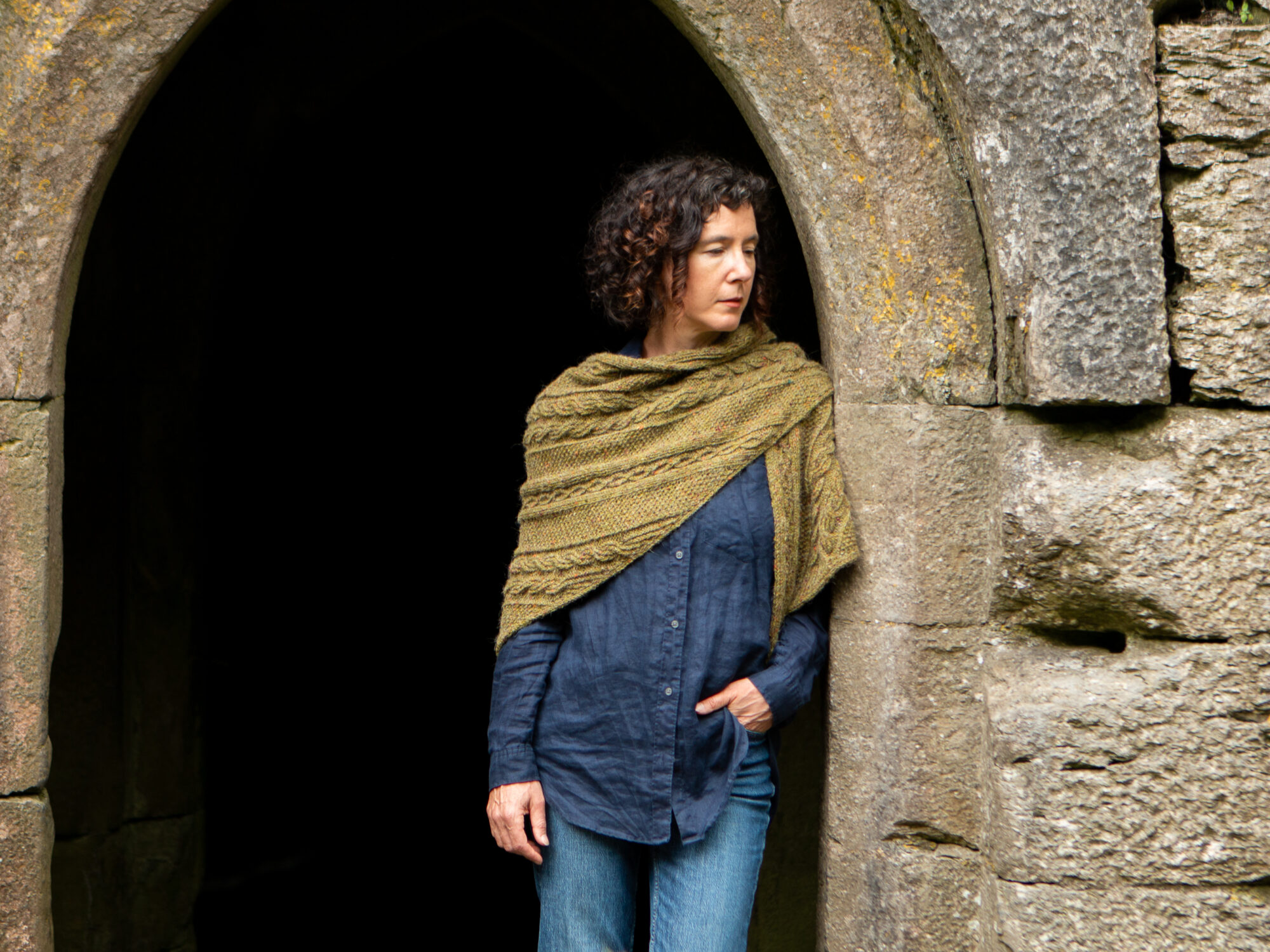
The Corna shawl is Eimear Earley’s second instalment for this year’s Celtic Knits Club.Today, she’s here to tell us a little more about the design itself and what you can expect in our final club release.
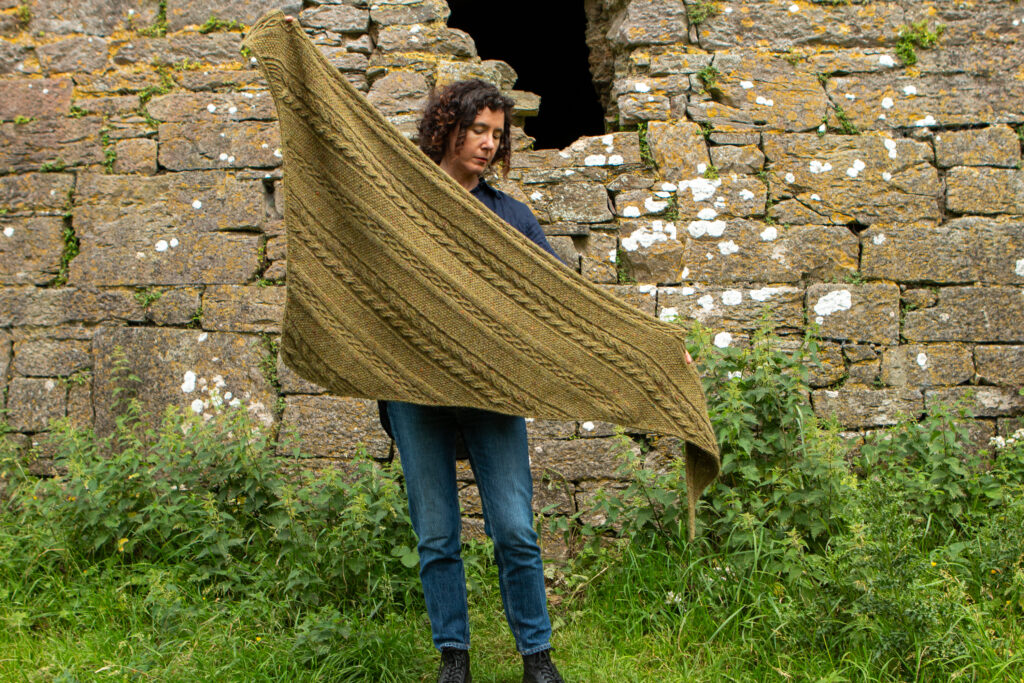
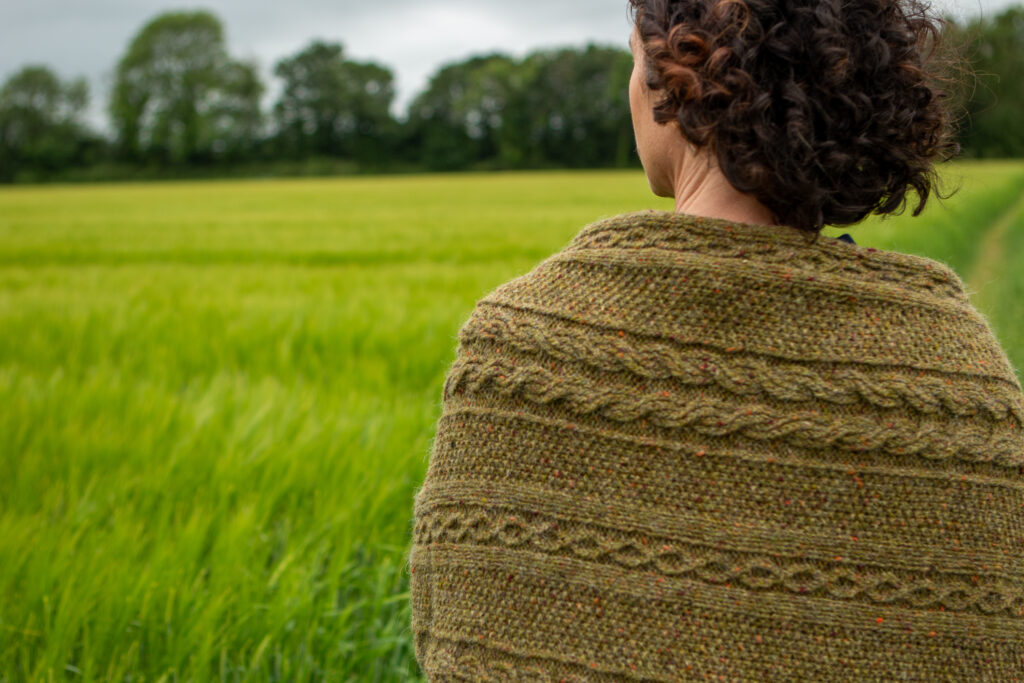
Corna (meaning ‘coil’ in Irish) uses two cable motifs that hint at rope cables, with a little added flair. The cable motifs use twisted stitches and ribbing and are separated by sections of moss stitch for stability.
The shawl is an asymmetric triangle, beginning with gentle increases along one side. Columns of cables are added as the stitch count increases. Once you reach the full width of the shawl, you will then begin to decrease. The rate of decrease happens more quickly than the increases, which give the shawl its asymmetrical shape.
Inspiration
Previously, I’ve written about how I have enjoyed delving into online archives to look at early examples of Aran knitting. For the Fiar scarf, I drew inspiration from a particular garment in the National Museum of Ireland’s collection, dating from the 1940s. This pullover has so many enticing details that I just had to delve a little more into its wonderful cables.
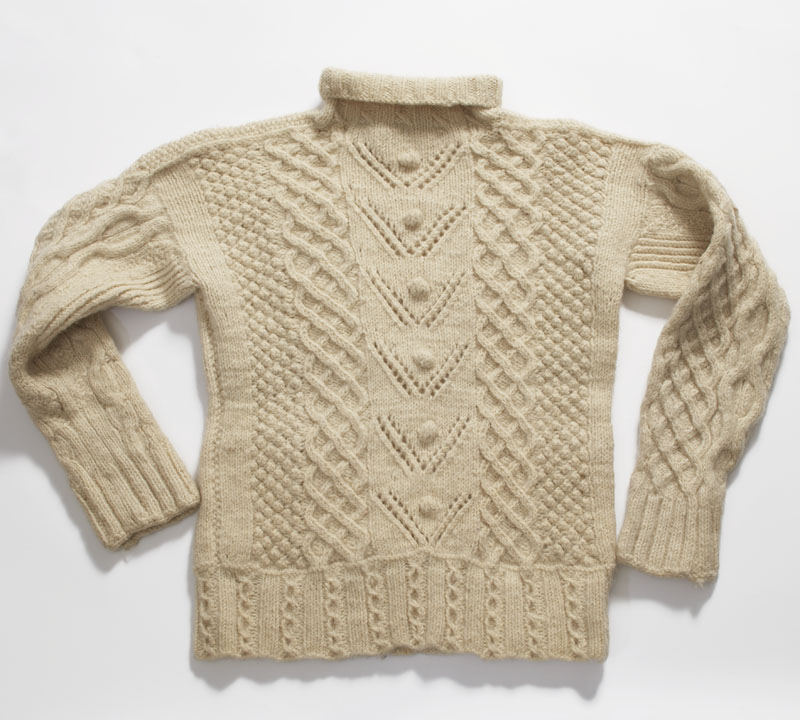
While browsing through images of older Aran knits, I found some familiar traits and a few surprises.
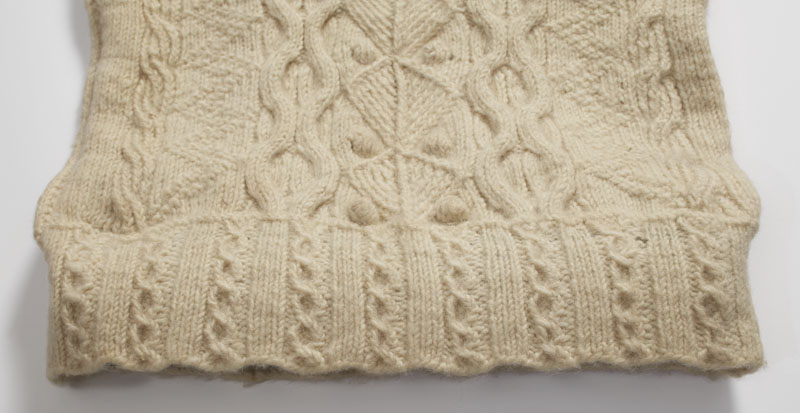
The older samples feature all-over patterning and motifs of stitches that cross over, as I’ve come to expect from Aran knitting. But I was surprised to notice how delicate some of the cable motifs were. The heyday of commercial Aran knitting often features wider cables, worked over multiple stitches. These earlier examples might have motifs worked with just a 1/1 cable crossing, and sometimes used twisted stitches, which makes the cable motif appear smaller again.
For this shawl, I focused on two cable motifs used within the 1940s sweater: a 1/1 cable motif used in the hem, and a motif used along the length of the garment that uses ribbing and twisted stitches.
Shawl Tips
The lighter Milis yarn used for this club instalment is particularly suited to these smaller, neater cables.
You may find it hard to keep track of multiple cables at first, especially as you’re setting up your first cable columns, but as you establish your repeating cables, you will notice that both cables are worked over 8 row repeats and are easier to keep track of.
The pattern uses twisted stitches throughout the cable motifs, worked from both the right and wrong sides of the work. If you have difficulty working twisted stitches – especially from the wrong side – you might want to experiment with working the cables without twisting stitches.
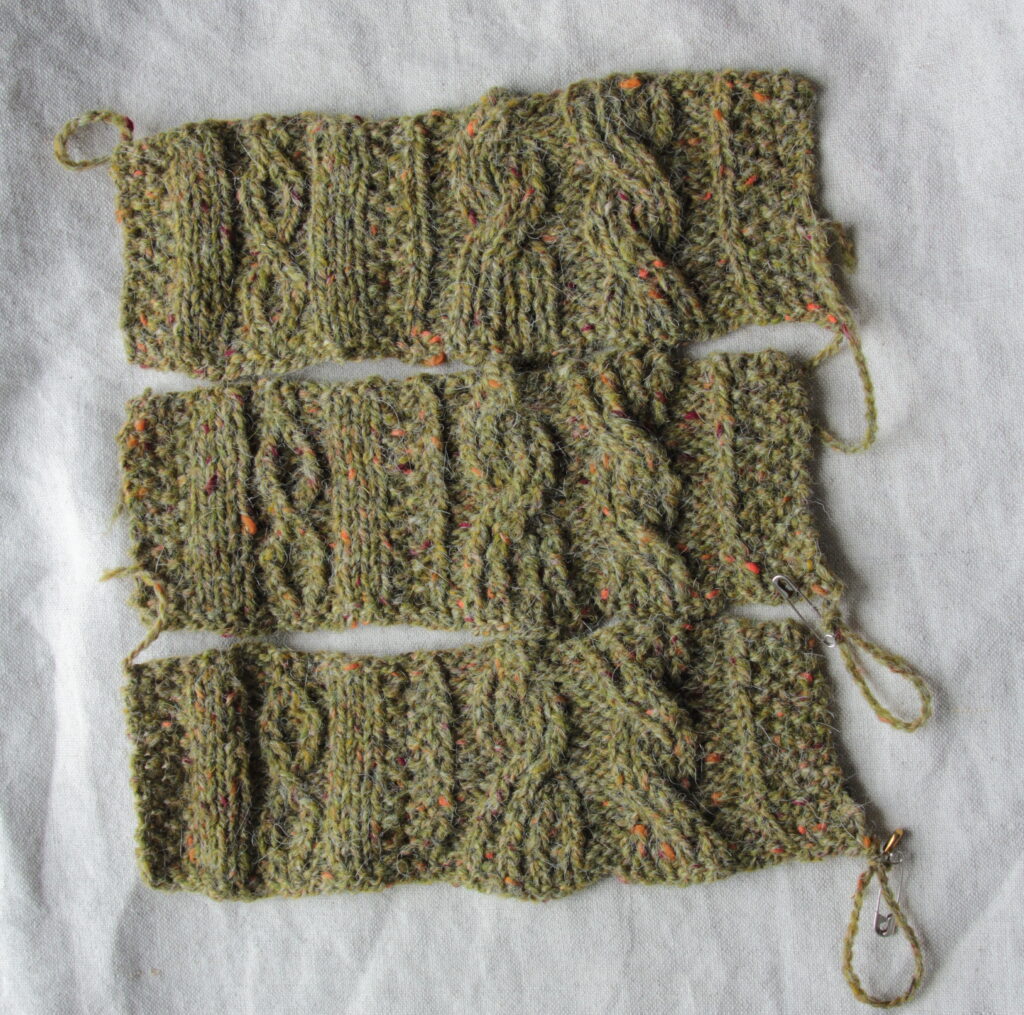
Middle swatch is twisting on the RS only – not twisting on WS rows.
Lower swatch is no twisted stitches.
Pattern Details
SIZES
One Size
FINISHED MEASUREMENTS
Width: 76″ / 193 cm
Depth: 27” / 68 cm
YARN
Stolen Stitches ‘Milis’ (70% Wool, 30% Alpaca; 245 yds / 225 m per 3.6 oz / 100 g); colour: Fern; 4 skeins
Approximate Yardage: 980 yds / 900 m
NEEDLES & NOTIONS
US size 7 / 4.5 mm straight or circular needles, any length, for working flat.
US size 7 / 4.5 mm circular needles, 47” / 120 cm or longer, for working edging or two shorter needles.
Always use a needle size that gives you the gauge listed, as every knitter’s gauge is unique.
Stitch markers, tapestry needle, cable needle.
GAUGE
16 sts and 25 rows = 4” / 10 cm in moss stitch after blocking.
Cable A panel measures 2.5” / 6 cm across.
Cable B panel measures 3.5” / 8.5 cm across.
Join The Club
If you’d like to join our 2026 Celtic Knits Club and pick up all 5 club patterns, workshops, and zoom live recordings head to our digital club here. Digital club members also have access to our exclusive CKC club yarns through private purchase links while stocks last.
MEET OUR FEATURE DESIGNER

Eimear Earley lives in Dublin, Ireland, with two small humans and a supportive spouse. Eimear originally learned to knit as a schoolchild, dabbling with leftovers of yarn and absolutely no concept of gauge or ease during her teenage years. After spending her student years playing with molten glass, she now gets her creative kicks from knitting and spinning wool—much more practical pursuits. Eimear loves to reinterpret old Irish things into modern knitwear, from ancient gold artifacts to less ancient cable knitting.
Stay up to date with all of Eimear’s designs and publications here.
Looking forward to tutorials